

Every Cinema is a Temple: How the Planets Show Up in Your Favorite Movies
When we watch a film, the planets disguise themselves as movie “stars,” and the story they tell corresponds with the aspects that are present in the sky at the time of the film’s release.

You're reading WOODRUFF. I cover the convergence of pop culture, psychology, and astrology—now joined by archetypal astrologer Robert Anderson as a contributing writer.
AS A TEENAGER, I WOULDN’T have been able to tell you why, only that Stanley Kubrick’s enigmatic film was gesturing toward something deeper than any single interpretation could permit. It wasn’t merely about evolution, space travel, or artificial intelligence—although it had plenty to say about these things—it was about the timeless spark of ingenuity that drives humanity forward.
Later on, I would come to understand the film as an expression of the era-defining Uranus-Pluto conjunction of the 1960s. I now see this alignment as a symbolic ‘master key’ that unlocks the film’s more profound meaning.
The Promethean spirit of that conjunction is writ large in the film’s overarching themes: rebirth and power struggle, epochal shifts, and the revolutionary—but also destructive—potentials of scientific and technological advancement.
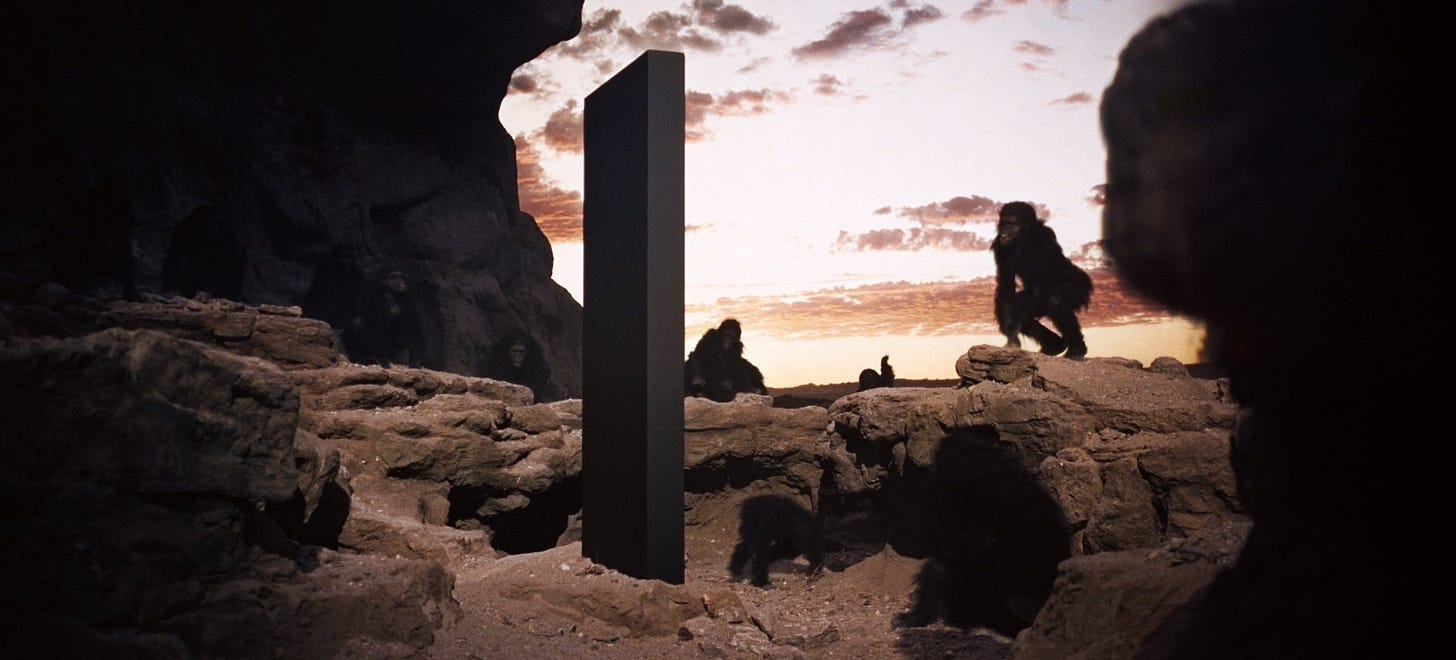
Its famous opening sequence, titled “The Dawn of Man,” distills these themes around a central visual motif: a black monolith that appears at critical junctures in the evolution of humanity.
In the distant past, the monolith suddenly appears amid a tribe of warring proto-humans and triggers an evolutionary leap—demarcated by the most iconic jump-cut in film history—propelling humanity from a state of prehistoric savagery (Pluto) into the burgeoning space age (Uranus) of the 21st century.
Following this dramatic transition, the film’s final act contains a warning about the perils of AI that reflects the shadow side of the Uranus archetype.
As Uranus and Pluto have now reached the opening trine phase of the cycle that began in the 1960s, this increasingly reads like a prophecy to users of Claude and ChatGPT—the archetypal descendants of HAL 9000.
Planetary Mise-En-Scène
Since the advent of filmmaking during the Neptune-Pluto conjunction of the 1890s, films have held a mirror to the ever-changing mise-en-scène of the night sky, reflecting its archetypal patterns in ways that are unique to the art form. As the dominant mode of storytelling in the 20th century, films nourished us with a sense of identity and meaning. They seeded the collective psyche with evocative images that were capable of inspiring action, instilling fear, and pulling on our heartstrings.
In these disenchanted times, this wellspring of sound and imagery is part of our cultural inheritance and one of the primary ways that we relate to the archetypal powers of the universe outside a religious context.
When we watch a film, the planets disguise themselves as movie “stars,” and the story they tell corresponds with the aspects that are present in the sky at the time of the film’s release. Through this ritual, we feel the movements of the world soul. We suspend our disbelief and allow ourselves to be enchanted once again.
Every cinema is a temple, every fandom is a cult—and the sky tells us which gods or goddesses are likely to be dominating the box office at any given moment.
Everybody Needs a Montage
Think of the legendary training montage from Rocky, which made a star of Sylvester Stallone. This is where many people go when they’re seeking motivation, when they need to summon the positive qualities of Mars, the archetypal athlete-warrior.
When the film was released in November 1976, Mars was exactly conjunct the Sun and opposite Jupiter. This alignment represents a convergence of masculine energies that clearly resonate with the ‘sports-drama’ genre of movies, for which Rocky provided the blueprint; it signifies a heightening of energy and stamina and a desire to press forward in pursuit of one’s goals, no matter the odds.
Moreover, Rocky’s onscreen opponent—the reigning heavyweight champ Apollo Creed (Carl Weathers)—takes his first name from the Greek god of the Sun, a symbolic nod to the solar activation that was taking place in the heavens when the film was released. In essence, Rocky is about getting into a brawl (Mars) with a Sun god; pretty on-the-nose symbolism for a Sun-Mars conjunction!
This alignment also resonates with the Sun-Mars sextile in Sylvester Stallone’s natal chart, the exact Sun-Mars sesquiquadrate in Weather’s chart, as well as the Sun-Mars square in Muhammed Ali’s chart—Ali provided the inspiration for Weather’s character.
The Retrograde Aesthetics of Barbie
More recently, Greta Gerwig’s film Barbie became a cultural phenomenon when Venus—the cosmic fashionista and dancing queen—stationed retrograde in Leo in a square alignment with Jupiter and Uranus during the summer of 2023.
In the world of the film, Barbie (Margot Robbie) inhabits a matriarchal utopia where life is an endless dance party and women occupy all the most prestigious roles in society. Men, meanwhile, are relegated to demeaning supporting roles, such as “beach,” in a playful inversion of patriarchal stereotypes.
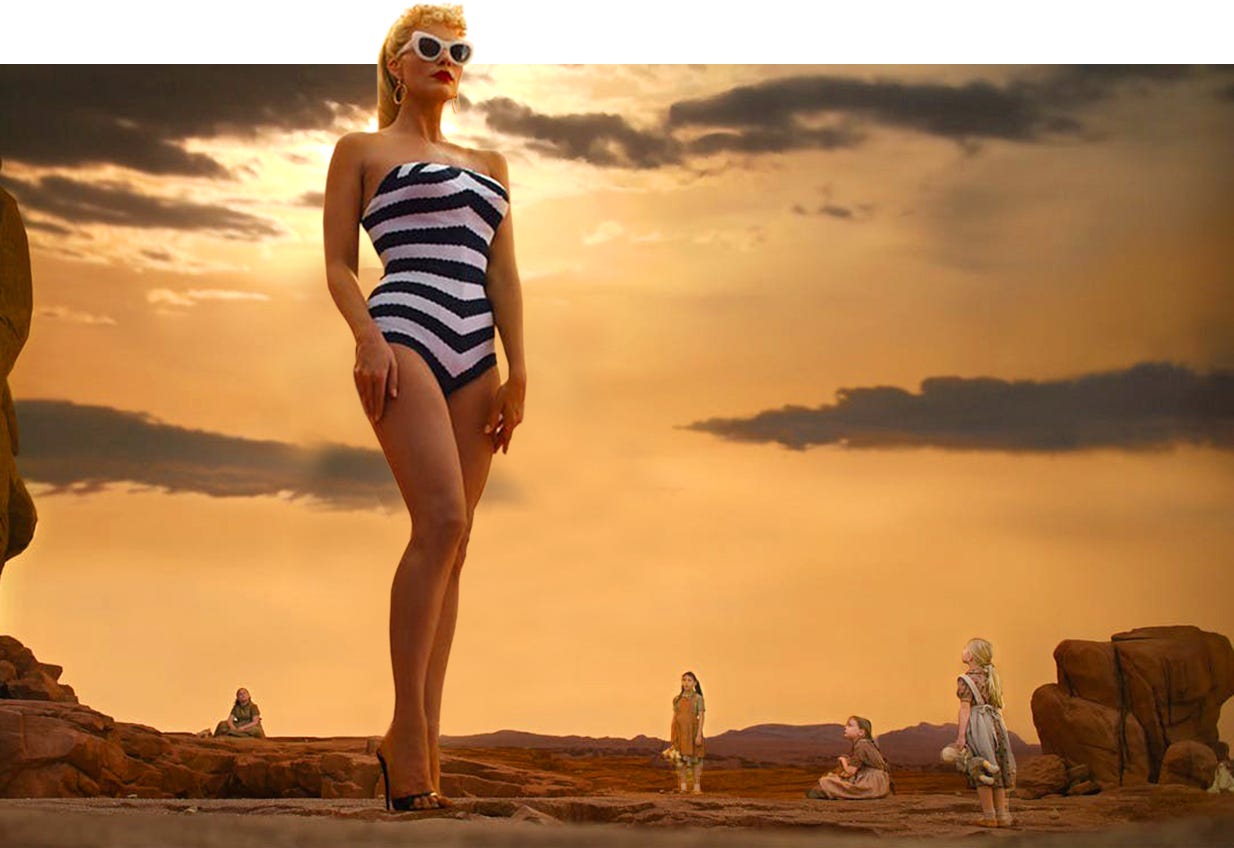
The film opens with a send-up of 2001: A Space Odyssey, in which the monolith (Uranus) is swapped out for Barbie (Venus), her arrival heralding the liberation of young girls from the single track of motherhood and their awakening to new vocational and consumer identities—as well as impossible beauty standards.
The film was a runaway success at the box office; it turned “Barbiecore” into a mainstream fashion trend and went on to secure eight Oscar nominations and a win for Best Original Song. Barbie-mania persisted throughout the Venus retrograde, reflecting a continuous activation of the Venus archetype across the culture—excited and amplified via the sustained square with Uranus and Jupiter.
This prolonged alignment also coincided with the zenith of Taylor Swift’s cultural ascendancy during The Eras Tour, when enthusiastic Swifties generated measurable seismic activity—or “Swift-Quakes”—as she moved from city to city. When Venus and Uranus align, the goddess of music and dance likes to shake it up (and off), sometimes literally.
This liberation of the Venus archetype was crystallized in Barbie, which front-loaded its feminist message with a hot pink spectacle of technicolor kitsch and catchy musical numbers. The film’s neon color palette flaunted the Venusian impulse towards style and sensuality—and these qualities were expressed in a humorous and over-the-top way that is very typical of Jupiter-Uranus alignments.
The film was not without controversy, however. Gerwig walked a fine line between acknowledging the problematic side of Barbie while also delighting in the hyper-feminine aesthetic of Barbie-land. Many saw the film as a joyful reclamation of feminine qualities that have often been dismissed as superficial or ridiculous. Although many critics of the film found its pop-feminist meta-commentary to be muddled and unconvincing.
Astonishingly, the film’s director, Greta Gerwig, was born during a previous instance of Venus stationing retrograde in square aspect to both Uranus and Jupiter—alignments such as these are exceptionally rare. This happened mere days after Madonna first broke onto the music scene with her debut studio album in the summer of 1983.
From Madonna’s breakthrough to Taylor Swift’s ascendancy, and from the birth of Greta Gerwig to the release of Barbie. The cyclical alignments of Venus with Jupiter and Uranus demonstrate a striking correlation with the emergence of the archetypal feminine (Venus) into the culture. In exciting (Uranus) and widely celebrated (Jupiter) ways.
Moreover, Gerwig’s directorial debut, the exquisite coming-of-age drama Ladybird—which explores the classic Venus-Uranus theme of sexual and romantic awakening—was released during an exact Venus-Uranus opposition in November 2017. She followed this with an adaptation of Little Women that was released during a Venus-Uranus square in 2019.
This sort of astrological patterning is not uncommon.
It is frequently the case that filmmakers who were born during a particular planetary alignment will go on to release their definitive work during subsequent alignments of the same planets—as I have illustrated here with the correlation between the release of Greta Gerwig’s films and the cyclical alignments of Venus and Uranus.
Artists in every medium are often compelled to revisit the same themes over and over again, themes that are illuminated by their natal aspects and which find new expression as those planetary cycles continue to unfold.
I have so far been interpreting films about specific planetary configurations. But as we all know, at any given moment, the sky is host to numerous astrological alignments that all have their own unique qualities. Sometimes these alignments clash with each other, and sometimes they converge in strange, dramatic, or beautiful ways. We can never fully separate a particular aspect from the chart of which it is a part.
With this in mind, I would like to demonstrate how different astrological energies can cohere into a unified narrative—with a range of themes and motifs—that reflects the diverse array of aspects that were present at a particular moment.
Courage and Grand Adventure in Space
This is the chart for the Washington, DC premiere of The Empire Strikes Back, a monumental occasion in the history of popular culture.
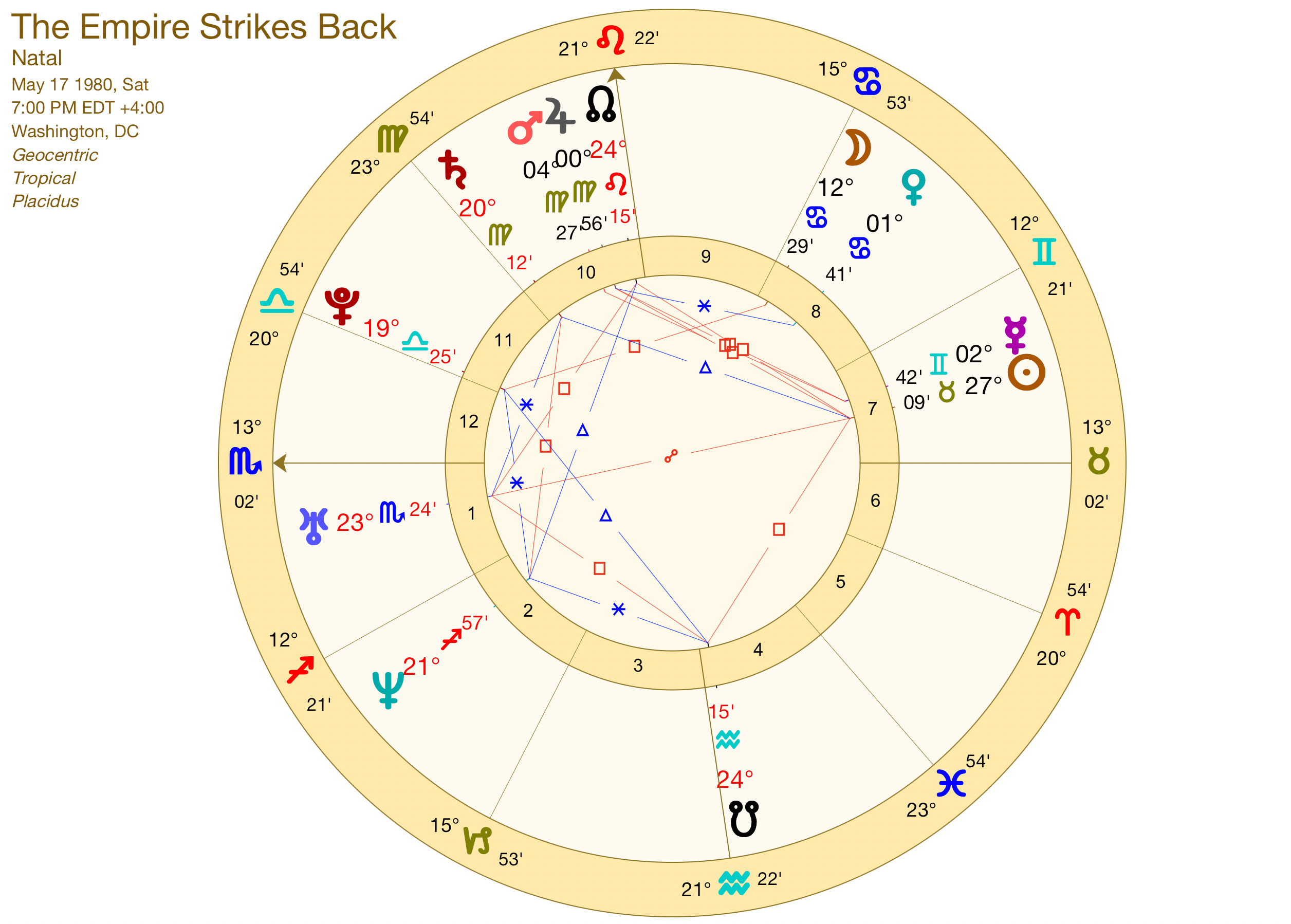
Breathe that chart in. Considered as a whole, it tells us more about the spirit of Empire than any synopsis ever could. Each aspect speaks to a distinct element of the film.
For instance, the chart’s Mars-Jupiter conjunction resonates with the spirit of courage and grand adventure that pervades the film, as well as the militaristic majesty of John William’s “Imperial March” (which was performed publicly for the first time during the applying phase of the conjunction). Williams was born during an exact Mars-Jupiter opposition, and his legacy as a composer is defined by this aspect.
By contrast, the Sun-Uranus opposition aptly symbolizes the shocking twist of the film’s climax—the revelation that Luke’s father is none other than Darth Vader—and the sudden rupturing of solar-heroic identity that this entails.
On the other hand, the Mars-Venus sextile signifies the push-pull adversarial romance between Han Solo and Princess Leia; their bickering and name-calling is infused with an erotic charge that finally resolves in a passionate kiss. If you’re in any doubt about this, just know that Harrison Ford and Carrie Fisher both have prominent Mars-Venus aspects in their charts, and the synastry between them is compelling.
Han: You like me because I’m a scoundrel. There aren’t enough scoundrels in your life.
Leia: I happen to like nice men.
Han: I’m a nice man.
Leia: No, you’re not...
Allow me to dive a little deeper into one particular aspect in the film’s chart: the exact square between Saturn and Neptune.
This square is what sets the film apart from the original. Tonally, Empire is a lot darker and more psychologically complex than A New Hope. The story comprises a ‘dark night of the soul’ experience for Luke Skywalker, who finds himself stranded on the foggy swamp world of Dagobah, where he trains under Jedi Master Yoda.
Saturn-Neptune aspects indicate spiritual trials, crises of faith, and experiences of cosmic alienation. Luke lives a sparse, monastic existence on Dagobah, where his spiritual fortitude is tested to its limits, and he is confronted by dark and disturbing visions.
His mentor Yoda embodies the positive Saturn-Neptune synthesis: he is at once the archetypal wise-oldman (Saturn) and the spiritual mystic (Neptune) who initiates Luke into the mysterious ways of the Force. Fittingly, Yoda was voiced and puppeteered by Frank Oz, who was born during a previous Saturn-Neptune square alignment (George Lucas was also born during this alignment); Oz’s work outside Star Wars also bears the hallmarks of this planetary pair.
The Saturn-Neptune square is where spirituality (Neptune) meets sacrifice (Saturn). This aspect can also represent the death (Saturn) of an illusion (Neptune) or an experience of profound disenchantment. This is precisely what happens when Vader is revealed to be Luke’s father: the idealized image that Luke held of his father as a noble Jedi is brutally shattered upon contact with reality. This revelation breaks Luke and marks the nadir of his journey.
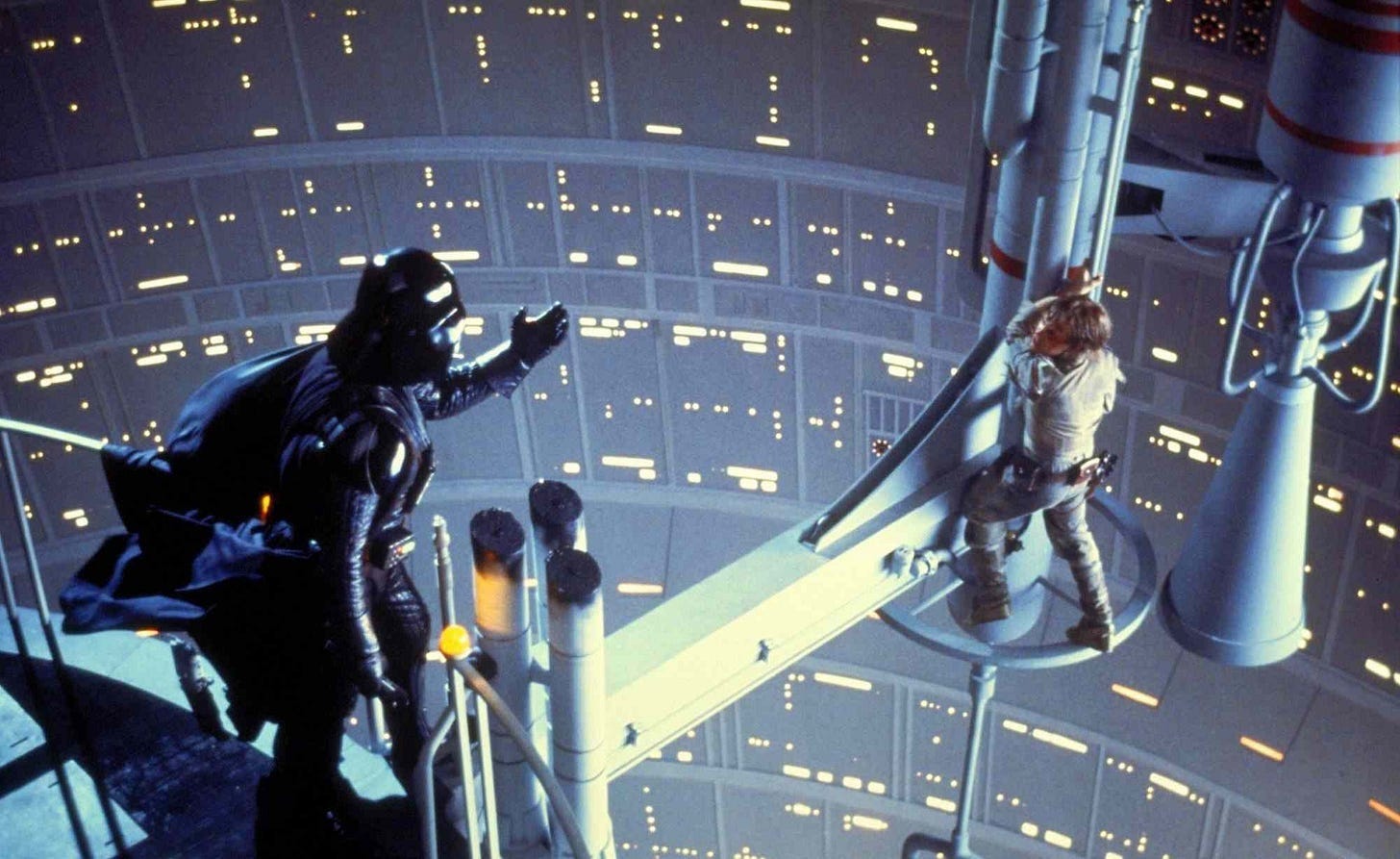
In this way, the Saturn-Neptune square—with its tendency toward disenchantment—combines with the Sun-Uranus opposition, which indicates a spectacular surprise (Uranus), particularly one that pertains to the archetypal father figure or role model (Sun).
In Empire, these two aspects dovetail uniquely; taken together, they perfectly illustrate the epic gut-punch of shock (Sun-Uranus) and disillusionment (Saturn-Neptune) that makes Empire the high point of the Star Wars saga.
As a final point, the chart’s Moon-Pluto square vividly illustrates the intense emotional turmoil that overwhelms Luke during his confrontation with Vader.
Search your feelings; you know it to be true.
Now that I have shared my astrologically informed approach to film analysis with you, I hope that you feel inspired to revisit some of your favorites with this new perspective in mind. If you’re anything like me, you’ll be amazed by the rich tapestry of cosmic threads that are woven into every creative act.
Cheers,

Robert Anderson is the creator of Archetypal Outlook, where he explores news and culture through the lens of archetypal astrology. Drawing on the work of Richard Tarnas, his writing blends in-depth research with up-to-the-minute insights into current affairs.

All images via YouTube screen caps.

• Astrology’s Upcoming Revolution
• Is Astrology Making You Crazy?
• Charisma: What’s YOUR Quota?
• Saturn: The Work and the Love
• When Mars Turns Against You—Uh oh!