


You’re reading WOODRUFF. I cover the convergence of pop culture, psychology, and astrology. Join my entourage of subscribers—you’ve been missed. My bio is here.
IN A POST FROM LAST YEAR, Bad Astrology is Everywhere, I detailed the shortcomings of what happens when the world’s second oldest profession (astrology) becomes infected by digital culture. As it exists now, the internet is a haywire expression of the collective’s id—with its wellspring of con, grift, and unhinged fads. Astrology suffers from this cacophony. The woes of too much connectivity outweigh the benefits. Consider Trump’s re-election, the consequence of online vacuity, and the vestigial lore of his TV persona. As a footnote to the abovementioned post, I wrote, “People now have never been stupider.”
I recently discussed this dilemma with another astrologer, and she told me, “Well, people tend to be drawn to astrologers online who are as disconnected from reality as they are.” To her point, I agreed. But added that the situation would only mutate until something came along to explode the strange attractor principle. Which, of course, got me thinking about Pluto’s upcoming long haul through Aquarius.
Different schools of thought exist regarding which sign and planet are associated with astrology. In traditional astrology, Mercury ‘rules’ astrologers. In modern astrology, Uranus is associated with astrologers. I can roll with that. The sign Aquarius, supposedly, is the most fitting Zodiacal catchall for astrology and astrologers. And again, if we’re trying to generalize, I can see how that works. Astrology, as an art that uses scientific data, fits nicely on the Leo (artist) Aquarius (scientist) vector.
This means that Pluto’s ongoing transit through Aquarius will dismantle the key functions of those two signs. Pluto intensifies revelation, so what is hidden beneath the rocks or floorboards is exposed, reassessed, and either remade or scrapped. There is also an amplification of power with Pluto transits. Therefore, with the 25-year Aquarian transit, I believe astrology will begin to assert more influence in the cultural imagination, but only after undergoing ethical purging.
Reassessment and Pluto were on my mind earlier this year when I encountered an astrology newsletter with the headline: The Virgo Eclipse: Avoid March 14, 2025, Like the Plague… After scanning that, I recoiled from my browser and continued to scroll—but then I changed my mind and decided to stop and parse the ‘information’ the post was ‘offering.’ I was curious as to just how hard the grift was going to play out.
As is standard with ‘catastrophic’ clickbait astrology, the post was a mixture of low-grade effort and hyperbole. When I saw the chart that accompanied the advice being dispensed, I knew I’d officially fallen—and wouldn’t be getting back up for a spell.
So, OK. Like, what the fuck is happening here?

This isn’t a horoscope; it’s a Rorschach of mental illness (the astrologer’s). I rarely discuss asteroids (and my disregard for them) when compiling a birth chart, but strap yourself in, as I’m going to sail into that Sargasso Sea now.
As I practice astrology, the planets aren’t archetypes, symbols, or stand-ins for synchronicity. Those ideas are reasonable and make it easier for a person to approach the mystery of astrology and make peace with it. But if you consider the Earth a living organism, like all the life forms that inhabit our planet, you can regard the other planets in our solar system in the same light. The planets, the Sun, and the Moon are alive. Like all living beings, their influence registers within the stream of time that we call ‘life.’
This isn’t a concept or contention. I see reciprocal relationships throughout nature as a fact. Whenever I’m asked, “Do you really believe in astrology?” My response is, “I don’t believe in things you need to believe in to practice.” I’m an empirical mystic—a direct-personal-experience type of person. And my approach to astrology doesn’t require faith, just the phenomenon of being alive with the ability to recognize and respond to other living beings.
Asteroids are pulverized chunks of dead planets. Their diminishment occurs through collisions with other asteroids, planets, and moons, causing them to break apart into smaller and smaller pieces—on their way to the sandpile. Unlike other life forms in our solar system, the asteroids are not ‘evolving.’ There is no astrological ‘there’ there. Apologies to those who believe the asteroids exert influence. You do you. But I don’t employ them in astrology for the above reasons.
Anyway, back to my argument here. I’m sharing the chart above as this was posted earnestly as an adjunct to the newsletter’s smattering of ominous ‘tips’ about the upcoming Virgo eclipse. The entire post was flashing red about various woes and troubles. The list crescendoed like this:
“If you have the Sun at 23 Libra, [the troubles] will be about your marriage. If you don’t have your modern astrology chart, you can pick one up with a trial US $7 membership at my website.”
This is a garden-variety astro-grift. As a prop, the asteroid-choked horoscope conveys pop-eyed confusion while implying that the astrologer can make sense of the nonsense. This plays up the power disparity between the astrologer and the reader. As in, “I can delineate this shit, and you can’t, so when I say your marriage is threatened, you should trust me and send me seven dollars for blah blah.”
Other awful astrology was sprinkled throughout the post, like this bit of advice:
“..this Full Moon Eclipse in Virgo is best avoided…An eclipse is always a blind spot and, often, a cover-up...”
Eclipses are not ‘blind spots.’ If anything, they are the opposite. Their exactitude is often considered an intensified, aperture-like opening that might reveal answers to questions or concerns. Full Moons frequently coincide with clarity, closure, and ‘ah-ha’ moments—revelations. Not ‘blind spots.’ If someone is in denial about a particular issue, an eclipse could feel troubling, as the full Moon component is akin to a ‘this-has-run-its-course’ confirmation. And people often have difficulty letting go of what’s spent in their lives.
The fearsome, negative qualities associated with eclipses drift back into the mists of time and are irrelevant to how eclipses are viewed, say, within the holistic school of modern astrology, as taught by folks like Dane Rudhyar. I’m not saying Rudyhar’s approach is the only one in astrology. But he did move astrologers to think beyond the pessimism that plagues so much of traditional astrology’s event-oriented obsessions. And that brings me to my main point in the post—how Pluto’s transit through Aquarius might restructure the astrological matrix.
Pluto’s Roto-Rooter-like function, over time, should shove our current astro-imbecility phase into an Emperor’s-New-Clothing spotlight. This will be a slow process, but it can potentially remake our culture’s relationship with astrology in exciting ways. This is one of the functions of bad players in the world. They display in detail the gold from the crap. One of Pluto’s central motifs is the path of ‘via negativa,’ where we learn what’s worthy by experiencing what isn’t.
Gen Z’s embrace of astrology is no different from previous generations. People are interested in discovering ‘meaning’ in their lives. Although I imagine Pluto’s opposition to Leo will shift astrology’s focus from navel-gazing individuals to groups, parties, classes, and how technology continues dismantling and reshaping society. Ongoing threats to our species’ survival from climate change will be a part of this reorientation. As will the retrogressive political ideologies like MAGA and the denialists that comprise the cult.
On that note, I have concerns that astrology will land in the crosshairs of Christian nationalists amidst their crusade against trans and gay rights. It’s a small adjustment to move on from those ‘deviant lifestyles’ and start attacking Wicca and the occult in general. Some of my worst memories from my novice days involved religious campaigns against the Tarot and astrology, which the church classified as demonic.
The fad of traditional or Greco-Roman astrology will morph into something more congruous, where traditional astrology’s fatalistic edge will be blended into modern, psychological astrology’s understanding of the human condition. This will be a welcome transition, as I consider the traditional school limited with its strict application of rules, laws, and wonky techniques. There’s too much theory amidst the application of thousands-of-years-old concepts. And too little humanity. As astrologer Stephen Arroyo noted about the existing fad of traditional astrology:
“Are we trying to create a cult, a religion, an ego trip? Or is it just another of the endless instances…of recycling old theories without testing and modernizing them? Although I have respect for much astrological tradition, I do not hold it in religious reverence.”
Of course, AI became the elephant in the room as Pluto moved into Aquarius last year. Every day, I see promotions for natal astrology being run through ChatGPT bots. As ‘modern’ and cutting-edge as this seems, it’s simply the latest veneer on creating horoscopes from cookie-cutter data entry that became popular in 1973 when Neil Michelsen launched his Astro Computing Services. I don’t need to do a diatribe on this phase of astrology; the shortcomings are obvious: a computer lacks imagination, a quality central to delineating a horoscope. And for those drawn to robotics for consultations, well, robotically spewed generalized data is what they’ll get. This is the spiritual fallout of the world squelched to zeros and ones.
As Pluto relates to excavation, anthropologists in different parts of the world may continue to make discoveries similar to the ancient Greek Antikythera mechanism, the oldest example of an analog computer that acted as a model of the solar system. Archeologists recovered the encrusted device from a shipwreck in 1902. However, new insights about what the device could do were still being published as recently as 2008. With anthropology, the past visits us in the present and inspires new paths into the future—or at least new ways of considering our commonality as humans. And as astrologers.
Like all Pluto transits, rearrangement and purging are necessary for the health of any structure, art, or doctrine. When ideas become static, they atrophy into automatism—or worse, authoritarian prisons. Because Aquarius is the most ‘human’ of signs, it’s encouraging to think that the cultural transformations that appear first as a shock (as we’re presently living through) will eventually lead to a less polarized experience of the world.
Astrology, as every culture has demonstrated throughout history, is humankind’s most inspirational confirmation that we participate in a vibrant, reciprocal, ‘living’ universe.
Love,

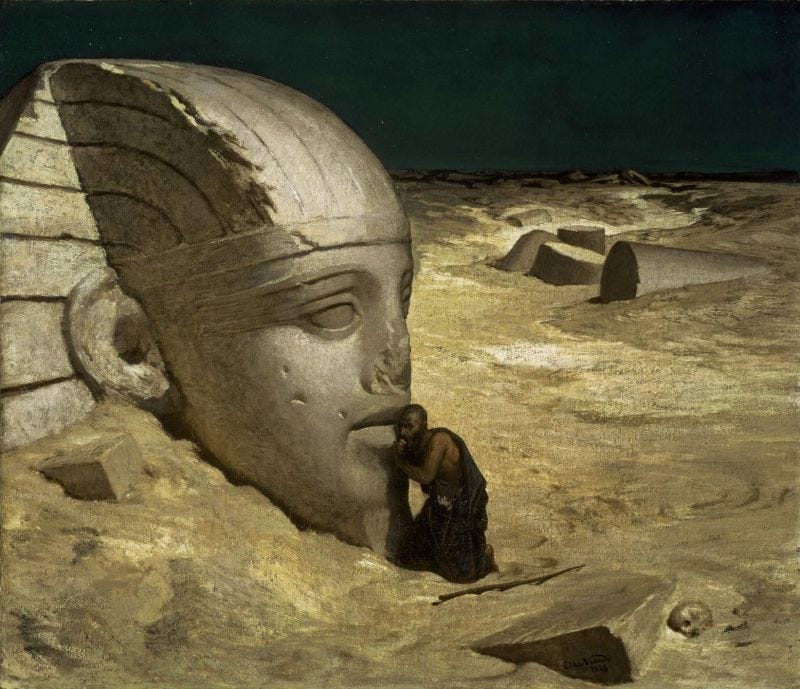
Opening painting: The Questioner of the Sphinx, Elihu Vedder (1863). Public domain.

• Is Astrology Making You Crazy?
• Charisma: What’s YOUR Quota?
• Can Science Prove or Disprove Astrology?
• Mark Zuckerberg: Trouble Child
• When Mars Turns Against You—Uh oh!
Thank you for so clearly sharing this. I saw that gobbledygook chart on FB and just rolled my eyes. I also appreciate your view on the asteroids. My own teacher (Noel Tyl, now deceased) did not use them. He pared down the data to the "Big Bells", as he called them. I love your view (mine, too) that the planets are alive, on their evolutionary paths, and I believe we are all evolving together. Thank you, Frederick!
Modern astrology was "the way to go" when I began studying this vast, multilayered, multi-dimensional practice. I recognized almost immediately the potential for misunderstanding, projection, and intentional or unintentional abuse by those who practiced without adequate subject-matter knowledge or personal self-awareness. Traditional astrology, with it's roots firmly planted in concrete and historical context, was (in my opinion) the antidote to modern psychological practices.
As an editor of astrology books, I saw a lot of "cook book" astrology. That coincided with an early effort to create astrology "reports" and report software. In my opinion, these are on par with basic sun-sign astrology.
Nature and its cycles have always guided my thoughts about astrology and my observations about our human condition. Opening to the idea of other planets being alive is like walking between the towers in The Moon or High Priestess cards! "Of course they're alive!" is the realization, because they're part of this Universe. Earth can't possibly be the only "alive" entity.
Lastly, to quote you: The fad of traditional or Greco-Roman astrology will morph into something more congruous, where traditional astrology’s fatalistic edge will be blended into modern, psychological astrology’s understanding of the human condition.
I welcome this transformation!!