

Celestial Grift: Writing for the Astrologically Addled
“Is it real, or is it Memorex”—or ChatGPT?

You’re reading WOODRUFF. I cover the convergence of pop culture, psychology, and astrology. Join my entourage of subscribers. My bio is here. Curious about a consultation? Head here.
I AVOID CRITIQUING other astrologers’ writing. To do so can appear condescending, but—sorry—here I go! Since their inception, the internet and then social media have hatched thousands of self-proclaimed, unaccredited astrologers. And now, with the assistance of AI, those wily souls are publishing content that looks meaty—4,567 words on a New Moon in Gemini—but is essentially a thin gruel. “Is it real, or is it Memorex”—or ChatGPT? All the right qualities might be there, except for the heart and soul of the author.
I’ve been writing for money for over 45 years, and I can tell when scribing is being composed or finessed by AI. I knew the large language models, once set loose, would head directly for astrological literature. Astrology’s popularity is timeless; it never abates. The bots’ gobbling maws (thievery, actually) began chowing down on the heaps of cookbooks (Mars in Aries, Mars in Taurus, Mars in Gemini) that comprise a good amount of the astrological canon.
The cookbooks were priceless for helping astrologers refine their craft, but over time and practice, they would start gathering dust on the bookshelf. Or should have. What I’m saying is obvious: a horoscope cannot be delineated via attempting to piecemeal a totality via snippets from a book. What makes for a substantial horoscope reading requires the astrologer’s real-life counseling experience and the power and guidance of their imagination.
The other day I came across a Substack that was publishing labyrinthine essays on the individual Moon signs. Like 40 thousand words (or so it seemed) were churned out per Moon placement. The newsletter itself displayed all the hallmarks of AI saturation. All the images accompanying the posts—the art for the newsletter’s heading, the profile illustration of the author—all of it was chilled in the frost of AI generation.
When I trawled the various Moon sign descriptions, I recognized instantly the footprints of the aforementioned cookbooks. To compound the insult, AI had zhuzhed up the syntax with lots of New Age phrases that borrowed heavily from 1980s pop psychology (stuff about the ‘inner child’ and ‘soul hunger’).
Eventually, I clicked out, sat back, and wondered, ‘Who is reading this?’ Or more pointedly, ‘Who has the time to read this?’ and more grimly, ‘What kind of interior emptiness does it take to find this shit satisfying?’ That latter question depressed me.
So, good astrological writing? What’s it like?
Well, it’s no different from all good writing; it facilitates the thrill of discovery in the reader. Skilled writers write to encourage discovery. I don’t think this aim is consciously achieved, per se. It’s more about the life experience of the writer leaking into the syntax and bringing it to life. And so the reader picks up on this life force, too.
The writer conjures material that requires the reader to put skin in the game. Ideas that encourage the reader to think for themselves. The writer uses metaphors, analogies, pictures, and intimations that the reader fashions into insights—germane just to her. The writer spins a dream and invites the reader to step into that world.
And, again, the writer’s life experience is critical to this art-making. I had a new client last week tell me she was taken aback after booking a reading with an online astrologer who—she discovered before her appointment—was 23 years old. The client was 68. She canceled the booking.
Yes, I’m ageist
Writing like I’ve detailed above is difficult, and the effort—the chud chewing involved—is something that a chatbot can’t duplicate or capture. And that’s why I can always tell when I’m reading AI-haunted compositions—there’s no sweat showing.
Discovery while reading is different from being spoon-fed character analysis that requires no brainpower to parse and digest. To imbibe uncritically allows for dependency—maybe even addiction—thus my term: the ‘astrologically addled.’
In my essay Is Astrology Making You Crazy?, I wrote:
“People are often drawn to astrology because their volition has gone offline. This failure of faculty can occur for countless reasons. But dependence on astrological insights can foster a limiting kind of magical thinking. A passivity that requires a stream of astrological data to sustain the rationale for not engaging with life. ‘I’ll wait until Jupiter is conjunct my Mars and then get out of bed.’”
The same temperament that draws someone to astrology is sometimes, unfortunately, also tethered to a lack of common sense—shortcomings in judgment—what shrinks refer to as a ‘weak ego structure.’
Living is an ongoing odyssey—as the poet John O’Donohue noted, “It’s strange to be here. The mystery never leaves you alone.” Good astrology reminds us of this—and it’s the axiom that an ethical astrologer stands upon—and writes from. She knows that astrology can only inform us of so much.
As the renegade astrologer Antero Alii once said, “Life is bigger than astrology.”
Love,

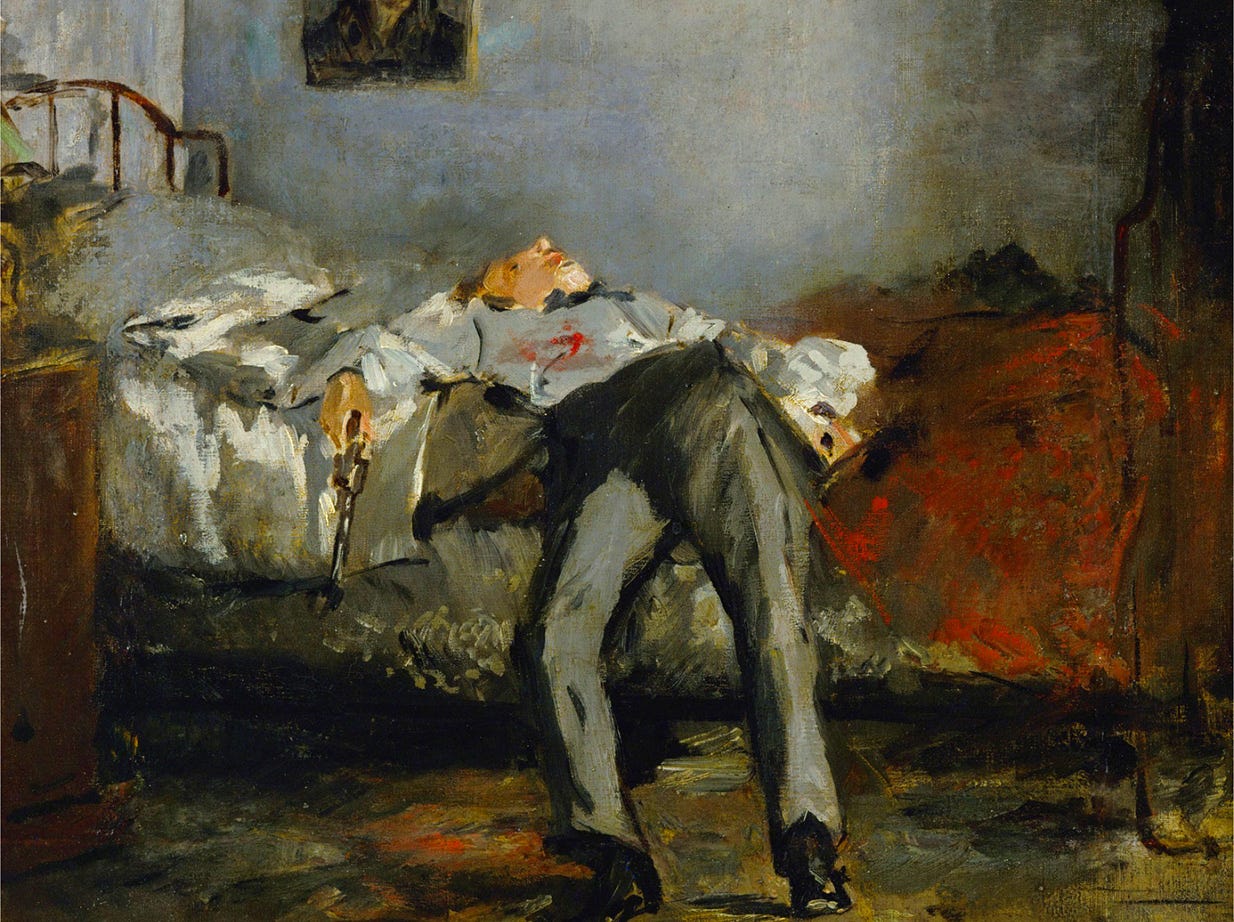
Opening painting: Édouard Manet: Le Suicidé (ca. 1877). Public domain.

• Person of the Year: Luigi Mangione
• Astrology’s Upcoming Revolution
• Is Astrology Making You Crazy?
• Astrologer and Tarot Maven TRAVIS BLACK on the WOODRUFF Cast.
• Charisma: What’s YOUR Quota?
• Saturn: The Work and the Love
• Nonsense & Malaise: Astrological Insights for Maneuvering the Hive
• When Mars Turns Against You—Uh-oh!
Try asking ChatGPT to draw your chart. The results are good for a pitiful laugh.
Frederick, thank you for this. It was pure gold for my ageist soul.