

Attack of the Fifty Foot-Crab
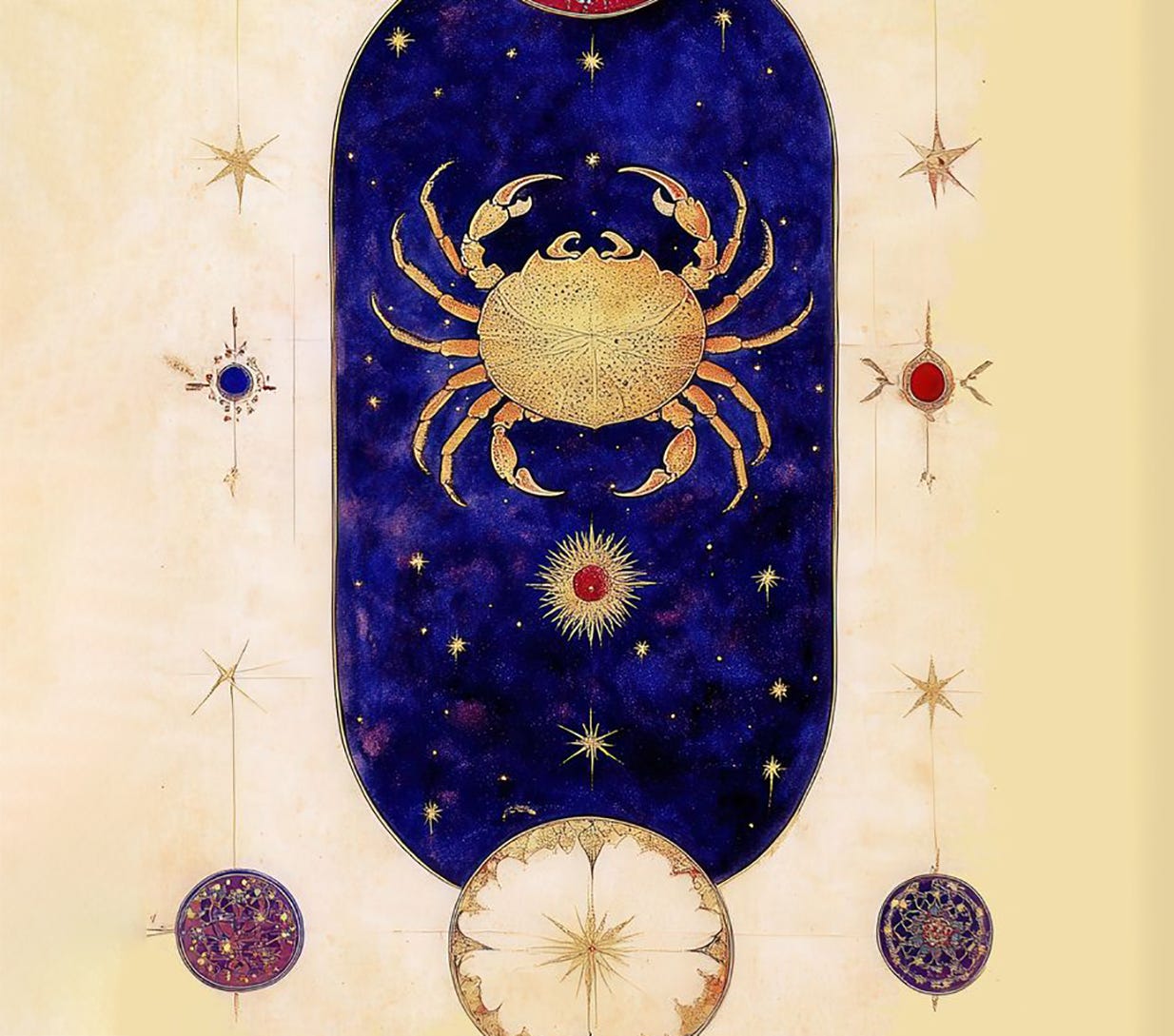
It’s summer solstice. Hail the crustacean! A reassessment of the Zodiac's most misunderstood mystery.


You’re reading WOODRUFF. I cover the convergence of pop culture, psychology, and astrology. Join my entourage of subscribers—you’ve been missed.

“Cancer has always had the reputation of being ambiguous and difficult to pin down, which, I feel, is a euphemism. It is in the nature of water and of the unconscious to slide fluidly from one shape to another, and it is in the nature of Cancer to live in a world where nothing is quite the same as it was five minutes ago.” —Liz Greene, The Astrology of Fate

WITHOUT INTENDING TO, the English mystical scientist Michael Faraday delivered a wonderfully succinct explanation of the secret workings of astrology. In his book Experimental Researches in Electricity, he wrote: “Matter is not merely mutually penetrable, but each atom extends, so to say, throughout the whole of the solar system, yet retaining its centre of force.”
So much packed into one sentence. How astrology might function, yes—but also how a particular—a single atom (or individual if you like) is part of the all-encompassing unfoldment of the whole. And then there is the word ‘matter,’ which is long considered part of the polarity that is spiritual/physical, heavenly/earthly, and paternal/maternal.
The word comes from the Latin mater—for mother. Matter is the ‘open sesame’ into the terrain of the Mother. And once evoked, Mother summons the secrets of the physical body. And it is our body that we usually leave behind in pursuit of transcendent states of higher consciousness. There is always this splitting away from our corporeality.
We take our bodies for granted because our physicality feels prearranged and is a given. We consider ourselves to be genies stuck in bottles. We also forget our origin and the astonishing fact that from one body emerged another body.
And you thought this article was about the Zodiac sign Cancer.
But back to origin. Our primordial origin—that of your mother’s mother’s mother’s mother’s mother’s mother. An eternal reflection into the maternal hall of mirrors. The place from which, apparently, according to scientists, all humans have a theoretical common ancestor: A mitochondrial Eve. Our original mom lived between 100,000 and 200,000 years ago in southern Africa.
Humans love discoveries like this because, at their root, they satisfy our drive to determine origin—the beginning, the first. We persist despite there always being an ‘x’ factor related to the quest. We continue to dream and imagine The Origin—the Original Mother.
Consider the predominant creation myth of our collective reality. Scientists have no compunction in declaring the Big Bang as our universal alpha. Hmm, Convenient.
Terence McKenna once remarked how scientists cheat regarding the Big Bang:
“This is the notion that the universe, for no reason, sprang from nothing in a single instant…notice that this is the litmus test for credulity…It is, in fact, no different from saying, “and then God said, Let there be light!” What the philosophers of science are saying is ‘give us one free miracle, and we will roll from that point forward, from the birth of time to the crack of doom.’”
So, we keep circling back to the beginning. To start questioning again. The Tarot depicts this wonderfully with the figure of The Empress sitting amidst her teeming garden, all of nature visibly on display—no secrets. But walk behind her, back toward the High Priestess sitting on her throne. Behind the Moon priestess is a curtain that no one can rent. What’s behind her lunar canopy?
From Eve. To pre-mother. To origin. To the mysteries of the Zodiacal sign Cancer. And like the crab zig-zagging her way forward, I’ve arrived at the start.
The Wanting Text
As a teenager and aspiring astrologer, I’d visit the crab last. I mean, I would skip to other sections of whatever astrological cookbook I might be reading to read about where my Mars or Jupiter was placed because reading about the Sun in Cancer was always a miserable experience. Men, who at the time had written almost all the astrology text available, never quite knew what to do with Cancer’s Moon-lit mysteries—and so developed a long tradition of marginalization. Best to minimize the uncontrollable, to jump over what wasn’t in one’s purview.
Aside from being an occupant of the worst-named sign of the Zodiac, Cancers suffer from Western culture’s composite forms of misogyny, a poisoned well that taints the waters that Cancer rules. Resentment and fear of the procreative powers of women, fears that occupy many strata in history, run deep. And so ambiguity and ambivalence continue to color what are supposed to be modern interpretations of the Zodiac’s fourth sign. And this is what I encountered in those books in the early 70s before psychological astrology had a foothold in the discussion.
If you spend time with, say, William Lilly‘s Christian Astrology (1647), you don’t encounter startling descriptions of the signs, ala Linda Goodmen’s Sun Signs (1968). Everything astrological in Lilly’s time was based on shapes and sizes and tangible qualities like dry or moist, places on a geographic map, or the ailments associated with each sign. Where all the other signs had maladies related to a specific limb or organ, for the sign Cancer, Lilly wrote: “It signifies Imperfections all over…”
Before modern astrology, there was, well, not much awareness of the interiority of the psyche, the notion of individuality, or the reality of the unconscious. This is why when you study ancient astrological texts, they read so extreme—riddled as they are with the polarities between good and evil, dignified and cursed, male and female. Some signs—usually those considered ‘positive’ and masculine, i.e., Aries, Libra, Saggitarius, etc.—benefited from the simplicity of describing extroverted and admirable (to men) traits—courageous, industrious, philosophical. Whereas the ‘negative’ or feminine signs were tainted by attempting to define characteristics that men considered vexing about women.
For a student astrologer, despite what he or she is told about the importance of the totality of a horoscope, it is always the twelve signs that lay much of the foundation for their studies. And so, as a teen, I was stuck with a decidedly male-oriented idealogy when it came to astrology. And it would be many years until a coterie of female astrologers (my teachers and the authors I was drawn to) opened a window on my Sun sign’s essential nature. And in so doing, turned all of my notions about astrology inside out.
The Dull Thud of Containment
“Let’s have some new cliches.” —Samuel Goldwin
Cancers are emotional. Well, other than a zombie, who isn’t? So that’s not worth much. Let’s go in for specifics. Here are some: Cancers are sensitive but high-strung, clannish, and protective—extravagant with their ability to nurture but parsimonious with cash. Fearful and retrospective but also defensive and moody. Oh, but we’re also good homemakers and cooks, but we have a tendency towards hoarding, which is sort of true. I have a sparsely decorated home, though goddess forbid you rummaged through my drawers and closets.
The 1930s astrologer Vivian Robson adds insult to injury with his physical description of the sign: “Pale complexion, often deformed face.” As a child, I was considered exotic-looking, with an inordinately large head and tiny eyes and ears, so maybe she was onto something.
I’m surprised the word ‘hysterical’ wasn’t included in the psychological descriptors for Cancer. Although hysterectomies are alluded to in the following. Here’s one of my astrological heroes, UK astrologer Charles E.O. Carter, describing the sign:
“…one sees Cancer well illustrated by a women’s tea-meeting, whereat the principal items of conversation are disease and operations, intimately described, and interminable family gossip.”
After the exhilarating rush of human potential that moves from a spark of consciousness in Aries to the bull’s lush enjoyment of corporeal pleasures to the Mercurial brilliance of Gemini, Cancer is a high-octane buzzkill.
Carter writes:
“After attaining the keen mentality of Gemini, what a fall it seems to pass back to a sign that is largely instinctive and has the reputation of wallowing in emotion, especially of the gloomier kind.”
Yes, now I’m really despairing. Carter continues: “Why does all this primitivity succeed the clear light of Gemini, wherein men are beginning to be truly human, real thinkers?”
Men on the move—being brilliant. Women busy coffee-klatsch-ing. Primitivity harkens back to origin—and so maybe Carter was on to something too. At least I read it that way now.
I’m doing some blatant cherry-picking from older books to establish my point and make you laugh. And yet, I’d venture that you’ll agree that whenever you read about the crab, the author stumbles through a maze of uncertainties—as if he or she doesn’t know what to do with the sign’s powerful alignment with the procreative elements of life. Qualities that most cultures and mythologies associate with the feminine.
And you can include, too, Cancer’s discursive intuition that can turn quickly into a dark tempest or prescient reverie. Behavior that didn’t find agency in, say, Plato’s analytical, male-centric symposiums. I remember explaining to my spiritual teacher (a male) once that periods of madcap chaos often precipitated my creative processes, and he replied that something must be ‘off’ in my relationship with True Nature’s metered flow. Yes, Truth, capital T, another purview of the rational male philosophers and gurus of the world. Dudes just don’t know what to do with the cray of the crayfish.
Considering the Sun’s astronomical position while traversing Cancer, much is revealed for such a seemingly shuttered house-bound sign. The heightened precognition (no other sign can track the public’s moods and fads with such sharp acuity as a Cancer) and pointed sensitivity associated with the sign are directly related to the summer solstice, which announces the sign regardless of the hemisphere.
Why? Because when the Sun has reached maximum influence. It doesn’t matter what its angle is to the Earth. The Sun is either higher, with more sunlight reaching the surface of the Earth, or it is lower, and its light is spread out over a larger surface of the planet.
In other words, northern or southern—there’s a lot of light. And that’s a lot of force. A lot of life. A lot of seeing and sentience. Heightened receptivity and reaction, as noted above—a kind of porous psychic sense—were considered unclassifiable by Victorian psychologists; thus, the ‘hysterical’ diagnosis was created to categorize the female temperament.
The most difficult part of my childhood (for my father) was my unapologetic fascination with the 1950s world of women and the accouterments that enhanced it. Cosmetics, fashion, jewelry, colognes and scents, gardening, flower arrangements, and pastry making. I also loved ironing. But also gossip and the dramas that roiled beneath the surface of our feigned family okay-ness. By the time I was seven, I was already psychoanalyzing my mom and her many mishaps in the romance department (she was married six times). Her interest in witchy subjects like astrology and Ouija boards also became a way to translate her unpredictable whims. And thus began my entry into the astrological matrix.
Women dominate modern educational astrology—the instructors and the students—especially in the United States. One would assume that reclamation of the art has taken place—and yet astrology has been mansplained for most of astrology’s history in the West. Traditional astrologer Alan White once explained in his biased introduction to Hellenistic astrology:
“Remember [Western astrology] is predicated on a philosophy that was put together by a man or group of men over about a 150-year period.”
OK, dear. But: Full stop. Really? White was one of my favorite characters in contemporary astrology’s pantheon of ‘splainers, but his certitude borders on the absurd. No one recorded how women thought about or interacted within the symposia of astrology (I mean that figuratively) to make such a claim.
This, of course, is the case with all forms of recorded history. Where men write books and manipulate or censor the book’s content and shape the narrative. Who knows how many more women like Hypatia, the Hellenistic Neoplatonist philosopher, astronomer, and mathematician, were engaged with astrology at that formative stage in Western astrology’s history.
As cultural historian William Irwin Thompson explains in his dazzling book Time Falling Bodies Take to Light: Mythology, Sexuality and the Origins of Culture, women invented astrology. However, because male archeologists tend to focus on archeological finds like tools and weapons, those items, they say, must be what everyone valued in the olden times. An example:
When a renowned specialist in paleolithic cave art discovered an engraved bone carved with markings that corresponded with lunar cycles, the notations were ignored, and the long stick was reclassified as a baton carried by military officers.
Thompson suggests that a lunar calendrical tally stick could have quite other uses than as a phallic expression of military power. He notes:
“The implications of the association of women and the moon would suggest women were the first observers of the basic periodicity of nature, the periodicity upon which all later scientific observations were made. Woman was the first to note a correspondence between an internal process she was going through and an external process in nature.”
This, of course, is what astrology is about in a crab shell.
And this is a critical juncture to consider when considering Cancer. The fork in the road, where the magical element of the imagination (which Cancer, as the first of the water signs, is the central symbol), gave way to reductionist materialism, which eventually developed into what we call science. There is a schism between realism and the imagination (although, as James Hilman noted, realism is just another expression of the imagination, although it’s rarely viewed that way by the rationalists).
This is my central argument regarding traditional or Hellenistic astrology. Disconnected from the psychological, traditional astrologers haul out their lexicon of rules, laws, and formulas as if the universe (and psyche) can be mapped and trapped so effortlessly. A Cancer will tell you differently because they are too familiar with the kind of trapdoors that spring when they assume they’re standing on firm ground. The most uninspired astrological ‘readings’ I’ve ever experienced were from two of the most acclaimed traditional astrologers working today. Being a Cancer and not wanting to hurt anyone’s feelings, I remained silent while listening to jibberish about Zodiacal ‘releasing’ and checking the clock to see how many minutes remained in the exchange. I’d cry about the high fee for the consultation later.
Cancers excel at two things: Making art and making children. Both are tied to their inherent maternal skills—which is really another way of describing their affinity with origin. Not caring for children, I took the artistic path, and my career has been, well, wildly Cancerian. I’ve been through more ‘eras’ than a Taylor Swift tour, from painting abstract art to launching my own church to appearing as the host of a children’s daytime television show to running one of the largest gay erotic websites during the webporn explosion in the 2000s, to art directing for two major TV networks and then managing my own ad agency, to writing teleplays, to writing about astrology and most recently about serial killers.
Cancers function optimally while practicing crop rotation to keep the creative waters circulating. As a cardinal sign, Cancer—like Aries, Libra, and Capricorn—is an innovator. This makes them assertive when it comes to exploring new facets of the imagination. And courage is required when broaching the boundless world of the immaterial. As Tarot scholar Cynthia Giles notes:
“Precisely because the imagination is so vast and powerful, its domain so different from the solid, sensible world of the material, it is both very seductive and very frightening. Human beings have a great yearning to adventure in imaginary realms—but at the same time, they recognize the fact that explorers occasionally get lost there and can’t find their way back to ‘reality.’”
I’ve learned to succumb to the odd cycles and rhythms of my unconscious, which, as any Cancer can tell you, sometimes feel hypomanic, as if a tempest has suddenly conjured up from what seemed to be calm ocean currents. This is often referred to as Cancer’s ‘many moods,’ but that’s not accurate—again, it’s another minimalization. Although the Zodiacal symbol of the crab is apt.
Crabs live in the water. They live on the land. They emerge from their shell and scuttle about. And then they don’t—suddenly, they resemble an inert rock or a discarded bit of skeleton. Lights off. Nobody home. And it feels that way when the circuitry that powers the imagination has blown a fuse. The crab has miniature hibernation cycles throughout the year. I can always tell when I’m about to enter one because some idea that, prior, had simply floated past my liminal radar will grip me, and I’m compelled to retreat and devote unmonitored amounts of time to understand it. A framed slogan in my office from filmmaker John Waters reads: “Life is nothing without obsession.”
These are hallmarks of someone who has not given birth to or is raising children or working as an overseer of children. This is the type of excessive attention a mother needs to administer to their child. As Gurdjieff remarked to a student who had just given birth, once an individual has mothered (or fathered) a child, the parent’s life—within the economy of nature—is essentially over. They’ve completed their assignment. It’s the child’s oyster now. Their offspring is the shining apex atop the species’ continuous evolutionary motion.
For this reason, aside from being gay, I never wanted kids. I sensed this biological fact somewhere in my bones. I’d have been a great parent but an awful artist.
To outsiders, the Cancerian social mode seems highly neurotic. And it confuses the people drawn to Cancer’s inner circle of hyper-attuned attention and loopy humor. But this pull towards intimacy becomes problematic when the waters dry up. As astrologer Stephen Arroyo noted, all the water signs in the Zodiac are cold-blooded creatures and can turn impersonal in a heartbeat when they feel their defenses violated.
Of course, this is a double-edged sword. There’s nothing more cringe than when a Cancer goes to work invading someone else’s boundaries. A classic clash at play when crabs become entangled with fire or air sign folks who the crab feels the compulsion to mother or ‘guide.’ God help you when a Cancer starts to tell you what they think you need.
This article is symptomatic of Cancer’s combined gift and curse. The crab’s creativity is always haunted by the dark side of one’s alignment with Mother—origin—the realm of prototypes that are considered Platonic. Often, Cancers will squelch their creative offerings or give up entirely because they don’t measure up to their irrational standards of perfection. As my friend, the author John Calendo, always reminds me: “It doesn’t have to be perfect; it just has to be good.”
If this post seemed like it was dashed off in a moment of inspiration, it wasn’t. I think I’ve been working on pulling the ideas together here for over six months. This is why I charge people to read my work. The process of nailing the syntax down nearly kills me.
Happy Birthday to Crabs Worldwide! 🦀🎉 Let this rambly paean be a celebration of our zig-zaggy alignment with the source. As celebrated by Lao Tzu, who declared, “The Tao is called the Great Mother: empty yet inexhaustible, it gives birth to infinite worlds.”
Love,


⭐️ My new book, I Love You Jeffrey Dahmer arrives in July 2026! ⭐️
• Is Astrology Making You Crazy?
• Charisma: What’s YOUR Quota?
• Can Science Prove or Disprove Astrology?
• Mark Zuckerberg: Trouble Child
• Nonsense & Malaise: Astrological Insights for Maneuvering the Hive
• When Mars Turns Against You—Uh oh!
Frederick! This is a brilliant piece. I devoured it. For this double Gemini, Aqua rising with Mercury in Cancer, there is so much you’ve pondered and pieced together that dovetails with and sheds light on some of the gaps in my own ponderings about the split between matter and spirit and how spirit is transformed in the physical body (such a cancerian thing), but how messed up that relationship is culturally. Lately, I’ve been wrestling with my incorrigible propensity to attempt to live so many of my imaginings that my body is forever begging me to just stop!
2 of my sisters have Cancer moons and I was married to a Cancer rising man for almost 30 years and while I recognize the traits you write about in them, your point of view helps me so much to understand their internal experience. Thank you.
What an amazing article! You hit on so very many salient points- and captured the signs essence ( in my humble opinion) beautifully♋️🦀
Happy Cancer season and Solar Return to you 🌞