



You’re reading WOODRUFF. I cover the convergence of pop culture, psychology, and astrology with a bit of the Tarot and dream work tossed into the fray. Join my entourage of subscribers—you’ve been missed.

“I’ve learned that you can tell a lot about a person by the way she handles these three things: a rainy day, lost luggage, and tangled Christmas tree lights.” —Maya Angelou

I’VE ALWAYS PUT UP A CHRISTMAS TREE.
Despite the halfhearted participation (and groaning) of my boyfriends, I’ve faithfully, right after Thanksgiving, headed out and bought a tree to lug home—or cut down, after I moved to the very rural Vashon Island. It’s a ritual I rarely miss.
After visiting India some years ago, I returned home that winter, and the notion of putting a bauble-laden tree on display felt absurd.
This reaction is a rite of passage for anyone who ventures to India. Meaning, after India, your brain cells are radically rearranged, and you never view your world, or its customs, the same. I know that was true for me as a Westerner.
Christmas in America, after the dust and squalor of India, felt decadent. Almost vulgar. So I skipped the holidays that year—though I missed having a tree in the house.
Arranging the colors, shapes, textures, and lights on a tree is something like the unconscious process that’s involved in attempting to arrange one’s life in a way that matches his or her particular aesthetic.
It’s also similar to making a painting—the alchemy of conjuring art. Simpler, but no less magical.
I especially love, at nighttime, how light ricochets between the ornaments. As I’ve grown older, I’ve come to understand that the ritual of displaying a tree is a sacred act—although I’ve never fully understood why.
Most of us are familiar with the historical origins of the Christmas tree—the evergreen’s association with the pagan rite of celebrating the Solstice.
When the light of the Sun ‘returns’ in the Northern Hemisphere and begins its increase and ascent, the radiance grows stronger and longer through the ensuing months.
Master astrologer Dane Rudhyar explains that each Solstice sets in motion a process that transforms “the scattered and disintegrated remains of the previous cycle into a new organic whole.”
And after living through yet another year of Pluto’s final lurches through Capricorn, Rudhyar’s words sound doubly revitalizing. I’m ready to connect with the stirrings of a new organic whole. Aren’t you?
Christmas trees were displayed to honor the compounding of light and life. The fruits and trinkets that would decorate the tree honored the bounty and the wish of a successful harvest in the year to come.
And yet, the historical perspective of the Christmas tree never impressed me much. I mean, none of those facts would drift through my mind as I’d crash on the couch in the evening—no matter my age—and stare at the tree until I passed out.
Nope, another set of mysterious associations would inform my reverie. And it wasn’t until I concluded one of my favorite books recently that I began to make sense of my devotion.
That book was Martha Heyneman‘s The Breathing Cathedral. A fantastic interweaving of the cosmologies of Gurdjieff, Dante, Aquinas, Stephen Hawking, and others into a new model, a new interpretation of the universe we inhabit.
I was drawn to the book because, as a longtime student of Gurdjieff’s teachings, I was intrigued to see how Heyneman, a zoology student turned poet, brought Gurdjieff’s teachings forward and married them to the world of science.
The last chapter of her book is titled O Christmas Tree, and at first, the subject—the family Christmas tree—seemed an odd way to summarize all that she’d explored in the previous chapters. But eventually, I understood completely.
She opens the chapter by describing her physical discomfort while sliding on her stomach beneath the family Christmas tree one evening to place an ornament on a lone branch that remained bare.
All the while complaining to herself how the rest of the family was in another room, disinterested, gathered in front of a television.
She finally declares to her husband, who suddenly walks in on his wife lying face down beneath the tree: “Next year, I’m not going to have a tree.”
“Why?” he inquires. Because no one cares anymore, she explains. “It doesn’t mean anything to anybody.”
The chapter progresses as, one by one, other family members come into the room and begin to help decorate the tree.
As she explains, the tree has a magnetic pull about it, from the past and into the present, throughout the lineage of a family…
“as if the conical shape of the fir tree were an inverted vortex, exerting a centripetal force, drawing us at the same time upward and toward the center. It draws us together both in time and in space. It is reuniting us with our parents, who passed the custom on to us, and with one another.”
Finally, the tree is complete and radiant with light. And that’s when Heyneman has her revelation.
She hears herself speak to everyone gathered in the living room: “Do you know what it is? It is the whole universe, with stars and planets and plants and fruits and birds and animals.”
“Up there”—she points to the space above the tree—“is the invisible, out of which everything comes.”
“And the point at the top is the big bang, the singularity where everything enters into space and time. And then it expands downward, producing everything that is: stars and planets and fruits and animals and birds.”
She continues to make distinct associations: “…lights for stars and baubles for planets.”
“Someone must have intended that,” she continues. “I never thought about the meaning before but just blindly repeated the ritual, spurred on by the wish that my children should experience what I myself experienced as a small child.”
A Christmas tree is a magical transformation, she explains, filling a room with a finer kind of substance—something “vibrating at a higher frequency, many-colored, fragrant, softly glowing, exciting…” Making things feel more alive. “A wonderful intelligence was at work behind the appearances.”
It’s easy to forget how enlivening the Christmas season can actually feel. Despite the dull pall of commercialization and the various horrors people bitch about this time of year, it’s truly a season of enchantment. There is something ineffable in the air if you’re open to sensing it.
“This is the true meaning of esoteric knowledge,” Heyneman tells us. “That the way you have seen things done every day all your life has an inner, psychological, and cosmological meaning that will be revealed to you at the proper time when you are ready to make use of it to order your inner world into one harmonious whole.”
And the Winter Solstice does coincide with a quality, an experience of time that is sacred. The darkening of the light is more than just an astronomical happening that is related to the Earth’s angular relationship to the Sun. All of that darkness in the Northern Hemisphere begets a stillness, a settling, a reflection that mirrors awareness of our inner light, our inner life.
I think this is why Christmas touches us despite our knowing or understanding of what exactly is transpiring.
We’re caught up in the outer events that define the season, whereas in tandem, in secret, there is that gathering of the light, the chance for increased awareness and wakefulness.
And the Christmas tree is the perfect living symbol, a holographic condensation, you could say, of all of that light, all of that living, and all that is promised in the new year (the new life) to come.
Happy Solstice to each of you.
Love,


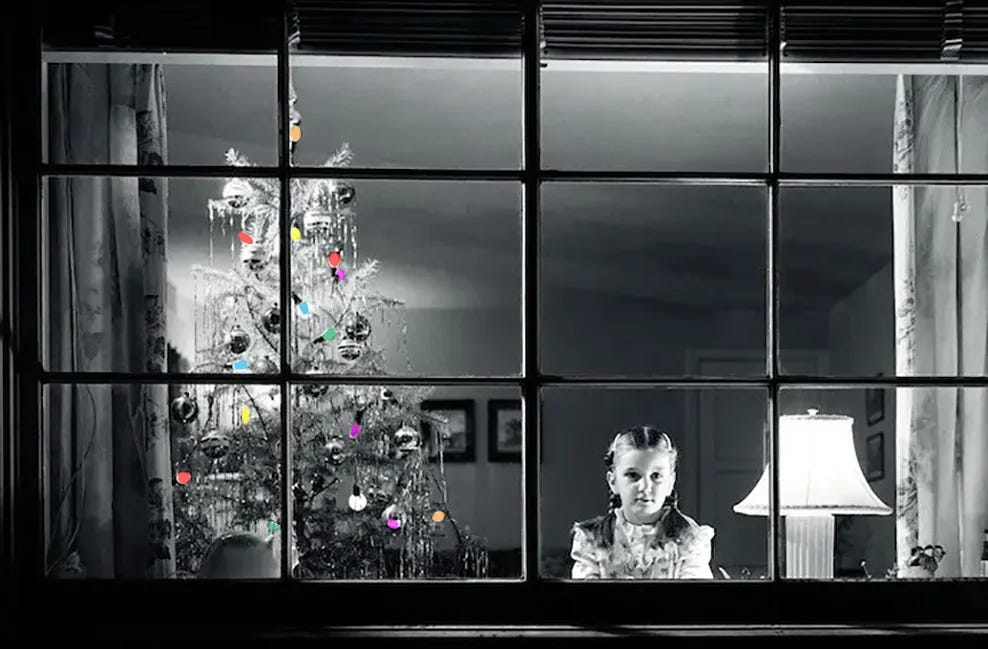
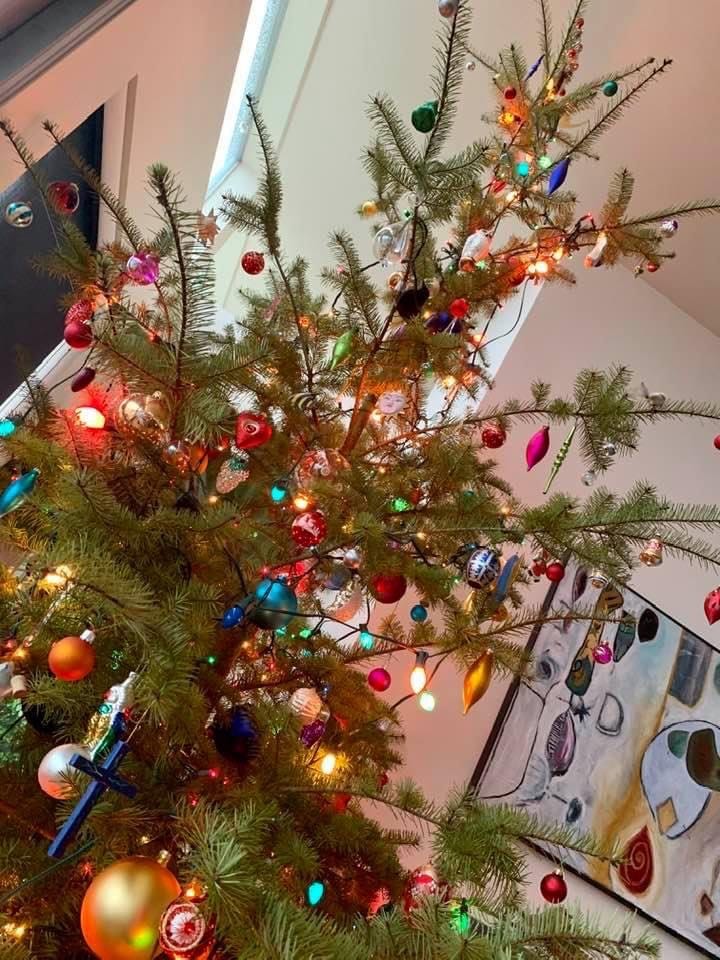
Opening photograph: Waiting for Santa, date and photographer unknown. My Vashon Christmas tree, photo by FW © 2025, Nightcharm, Inc.

• Is Astrology Making You Crazy?
• Astrologer and Tarot Maven TRAVIS BLACK on the WOODRUFF Cast.
• Charisma: What’s YOUR Quota?
• Saturn: The Work and The Love
• Nonsense & Malaise: Astrological Insights for Maneuvering the Hive
• When Mars Turns Against You—Uh oh!
Deeply moving! And a true inspiration in such a dark moment.
Thank you for this lovely piece, Frederick. I will be looking at the tree, and how I look at the tree, today more consciously. It calls to mind a quote that I am revisiting this morning after reading your newsletter...
"'I was a hidden treasure and I longed to be known, so I created the worlds visible and invisible' is how one of the great mystical sayings of the Islamic Hadith Qudsi pictures the primordial divine yearning for intimacy and self-disclosure that got the whole cosmogonic ball rolling in the first place. Each world along the Great Chain of Being is not merely the next step in a mathematical progression; it is a specific set of conditions that allows for the expression of some very specific aspect of the divine heart. And in fact, the word cosmos in the original Greek actually means "ornament.' If rather than seeing these worlds as beads on a chain, we saw them as balls on a Christmas tree, we might better understand how each of these precious cosmoses is beautifully and uniquely artificed to bring forth some specific aspect of the divine longing to be known. The chain links drop out, and you stand like a small child on Christmas Eve, bedazzled by the wonder of it all." - Cynthia Bourgeault