

George Harrison: Some Things Are Timeless
A Pisces with a Scorpionic chaser, the "quiet" fab lad was a ticking time bomb of songcraft and renegade mysticism.


“All things swim and glitter.” —Ralph Waldo Emerson

GEORGE HARRISON’S 1998 AUTOBIOGRAPHY opens with the dedication “to gardeners everywhere.” There is scant mention of his time in the band that John Lennon decreed “…more popular than Jesus.” But in I, Me, Mine, Harrison couches his years with the Beatles as just one of many curious events within the longer arc of his too-short life.
Are we surprised that a solitude-loving Pisces with a privacy-oriented Scorpio rising would shy away from his gigantic cultural persona and write simply about growing trees (Pisces) or his fondness for racing fast cars (Scorpio)? No.
Studying the historiography of the Beatles, especially while doing concentrated research, one is forced to conclude—if she is an astrologer—that water sign-dominated individuals would possess the fine-tuned psychic skills to secure their place (and maintain permanence) within the Promethean talents of Lennon and McCartney.
And this is exactly what Harrison and fellow water brother Ringo Starr (a Cancer) were able to do throughout the band’s ten-year tenure.
Cultural watermarks are marked off by the 20-year cycle of the planets Jupiter and Saturn. The conjunction of the two planets releases a galvanizing impetus into the collective that rearranges the aftereffects of the former 20-year cycle. This dance between the planets is the backbeat of any social cycle.
John Lennon was born during the exact conjunction between Jupiter and Saturn in Taurus in 1940. And the Beatles began their ascent to rule the world during the next conjunction in Capricorn in 1961. As the conjunction formed again in 1980 the one-two-three punch of the Beatle’s revolutionary arc came to a close with John Lennon’s murder.
Lennon was the driving force that linked himself and his bandmates into the larger cosmic cycle of the Jupiter-Saturn nexus. Tethering his band to an even more monumental Uranus-Pluto conjunction that came to perfection with the Beatles’ dominance of all things revolutionary on the cultural stage.
But with a relationship-driven Sun in the 7th house of ‘other,’ (a complex and contradictory placement for an Aries rising soul) Lennon needed a central object relation in his life, a partner that could match and mirror his genius. When Paul McCartney was recruited into John’s band, he met his complement.
Only a Mercurial magician like Paul, with his Gemini Sun and Virgo rising, could skilfully maneuver (or dodge) Lennon’s contradictive, belligerent and competitive Arian spirit. And continue to find joy and camaraderie as a creative partner.
When Lennon’s relationship with McCartney began to dissolve, Lennon switched allegiances instantly, falling into the tractor-beam presence of Yoko Ono.
To study the synastry between Ono’s horoscope and McCartney’s is to see the personification of a hair-shirt writ large in the stars (Ono’s Saturn in Aquarius riding hard against McCartney’s theretofore unchallenged Leo stellium).
We can thank the watery elements that dominated the charts of bandmates Starr and Harrison for allowing the Beatles to maintain their integrity for close to a decade. Both men developed coping skills to expertly morph and shift to accommodate the larger-than-life egos of Lennon and McCartney.
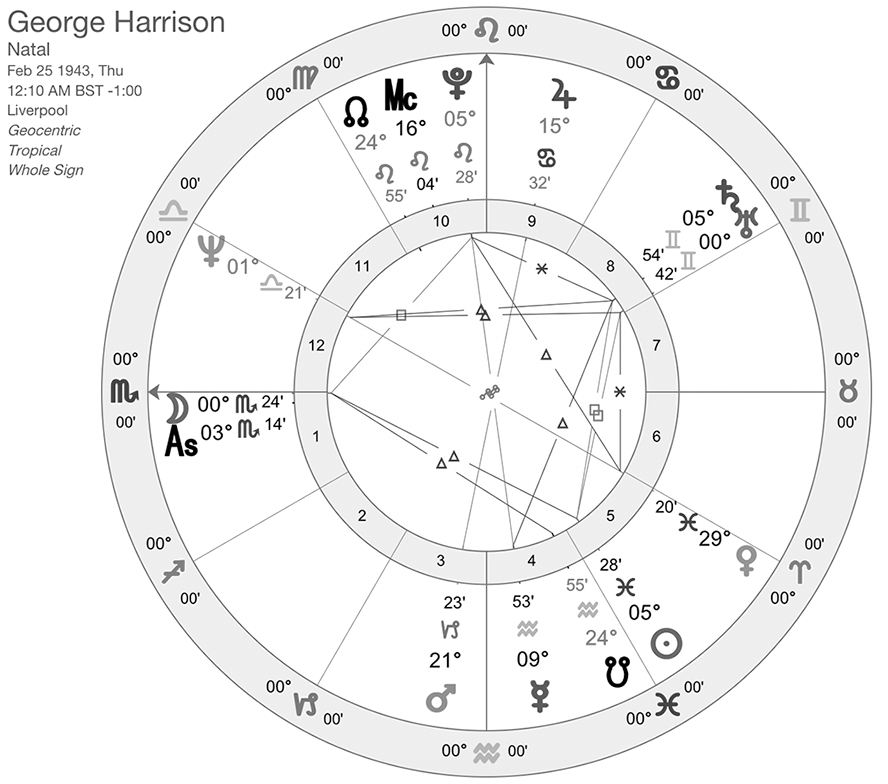
Ringo, with Cancerian loyalty, and Harrison by keener instincts, his Scorpio ascendant and Mercury-Pluto opposition made him a savvy realist regarding the large amounts of money the Beatles generated. Harrison’s Scorpio influence was akin to the catalytic molecules of the hardener that, when added to an epoxy’s resin, creates a solid bond.
Conversely, Harrison’s prescient Piscean nature initiated the strongest mutations within the band. Beatles producer George Martin credited Harrison with being the most committed of the Beatles in striving for new sounds. And Harrison would also be the solvent that led to the band’s eventual dissolution.
Like kids around the world, I was thrilled at the madcap antics of the Beatles in their first film A Hard Day’s Night. Although, as a pre-teen, I didn’t quite follow the wry double entendres that peppered the film. But the trailer for the movie first captured my imagination regarding George.
My empathetic nature was twanged in the scene where three of the lads are running away from a crazed mob (Paul was hiding somewhere incognito). But in their escape, George takes a gnarly fall, slamming into the sidewalk with his chin taking the brunt of the collision.
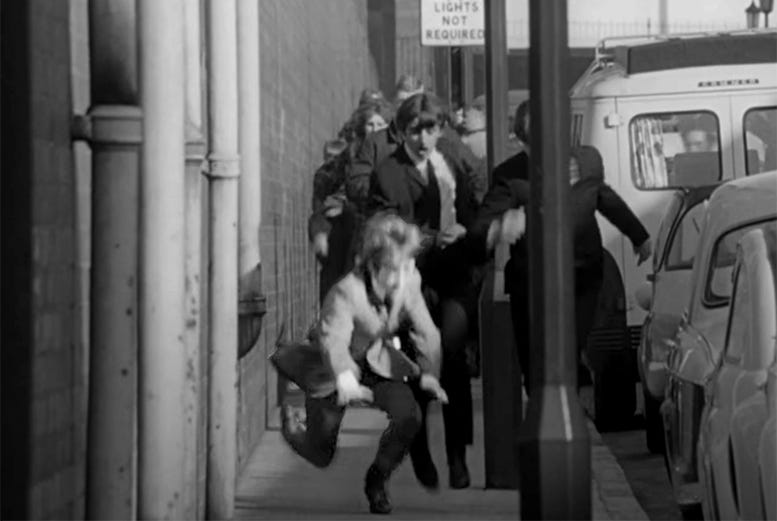
From that moment on, he was the Beatle that interested me the most. Was he OK? Did he bleed? Was he taken to the doctor?
A Hard Day’s Night’s pseudo-behind-the-scenes skew gave the impression that we were meeting the Beatle’s true personalities. And of the four, George’s grumpy, sardonic demeanor captured my imagination.
George came the closest to matching what queer royalist Quintin Crisp described as ‘the dark man.’ Of course, at eleven, I had no idea of this notion, but when I hit an age where I could trace my erotic responses to men, I understood my early infatuation.
Harrison’s birth chart was the first I drew up when I had the means to do so, and I was pleased to see we shared the same Moon sign. As Uranus squares the Moon in my chart, it makes sense that witnessing Harrison’s crash landing in AHDN would forge a ‘bond.’ From that point on, George became a sort of star twin for me. And my favorite Beatle.
Scorpio rising individuals inject themselves subliminally into the energetic field that unites any relationship. Their presence is registered in the moods and tones that others feel around them but often can’t define.
Their demeanor is quietly formidable, subtle, and riddled with trap doors or escape clauses. As intensely as they like to bond, an equal force bristles against suffocation.
Musically Harrison expressed this best in his song All Things Must Pass. After the lovely metaphoric allusions to sunset or sunrise, he drops: “After all this—my love is up and must be leaving.”
Consider Harrison’s spiritual influence on his colleagues. Before the Maharishi and visits to India, the other Beatles paid heed to his fascination with Bob Dylan and the Byrds’ folk-rock that dominated pop music in the 60s in the States.
Eventually, the Beatles followed George to India in search of Truth (and a respite from LSD). A sojourn that, like all Scorpionic initiations, contained as well the seeds of dissolution.
Returning from India and back in England to begin recording the ‘white album,’ fractures and flair-ups found a foothold within the quartet, and as John commented later, the album was the sound of the band destructing. But also much more.
The Beatles (the ‘white album’’s default title) is a shambolic omnibus that became the soundtrack for the collapse of the entire decade. And the psychotic inspiration for the infamous Manson murders. In her book, The White Album, Joan Didion writes that “the Sixties ended… at the exact moment when word” of the Manson murders circulated.
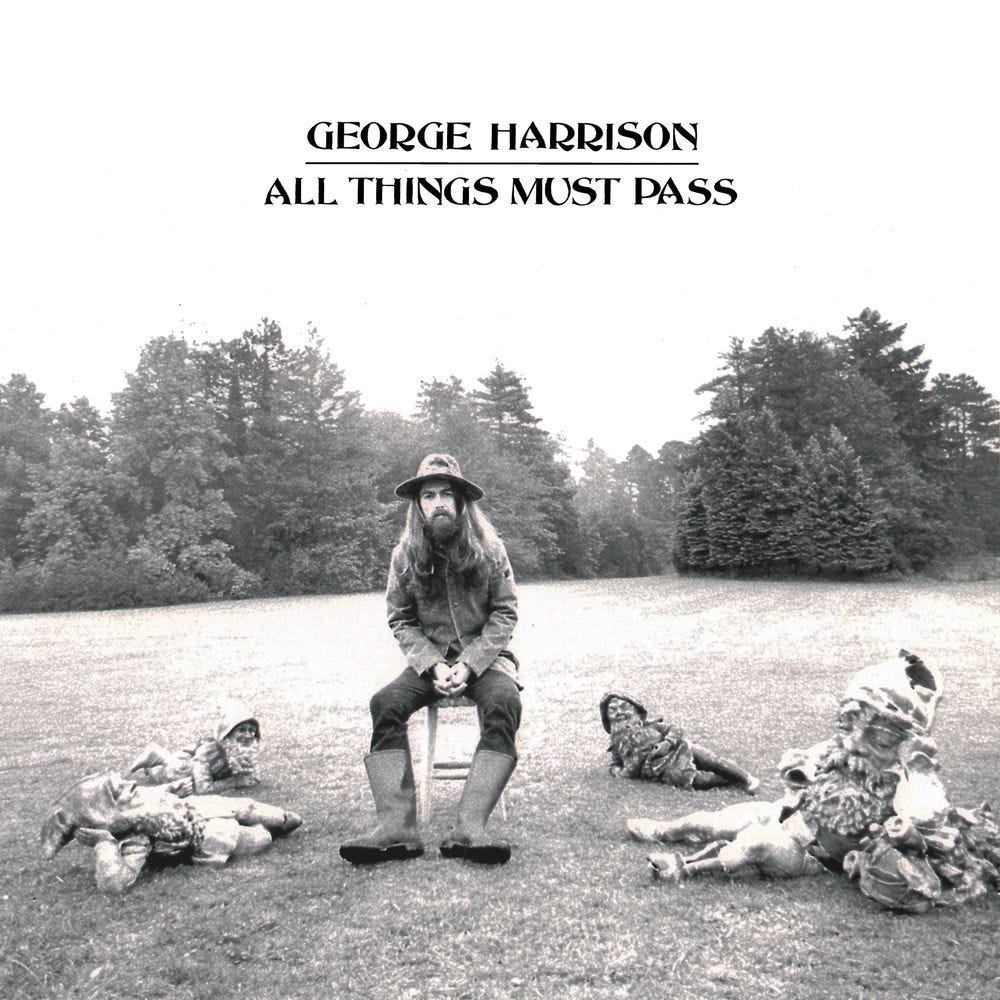
As the Beatle who got none or one or maybe two songs featured with each Beatles release, Harrison’s first solo outing, All Things Must Pass, was a storehouse of Harrison’s pent-up creativity and song-craft. A condition oddly out of sorts with the serene Rip Van Winkle-ish cover.
But then that’s the thing about Pisces individuals, the world of opposites is continually swimming in and out of consciousness. And their finest work arrives when those two different worlds are merged.
Consider Albert Einstein, another Pisces. His relationship to the imaginal was just as solid as his scientific excursions through the logic of mathematics. His vision changed our world.
As a Piscean prophet, Harrison’s presence was the alchemical ingredient that brought the most profound alterations to the Lennon and McCartney nucleus. George advocated for Starr to join the band after Pete Best was sent on his way.
And it was Harrison’s dentist who introduced LSD into the band’s tight-knit world. And, of course, Harrison’s fascination with Eastern religion (and the sitar) radically shifted the band’s sonics. And after a horrifying experience performing in the Philippines, Harrison was the first member to consider leaving the band.
George’s guitar playing was liquid and sliding, in keeping with his oceanic nature. His songwriting was unaffected and sometimes cyclic in structure (My Sweet Lord). Or druggy and otherworldly (Blue Jay Way).
Compare his version of If Not For You to Bob Dylan’s, which Dylan released two months before All Things Must Pass. Like Harrison’s demeanor, his version of the song is floaty and spacious.
When I purchased ATMP as a teen, it was like an ever-ready birthday present because the three discs were housed inside an actual box, not enclosed in those unwieldy gatefolds. The record company didn’t know what to make of this packaging request from Harrison. Only classical and opera albums were ever packaged in boxes. But being a former Beatle, who would dare counter his wish?
So each time you opened the record, you did so with celebratory anticipation. The square box was deliberately displayed, like an art piece, in front of my other albums. Harrison sitting there, surveying my room, like a miniature Buddha. The contrast to (or similarity with?) the gnomes made him talisman-like.
True to Piscean form (or lack thereof), photographs of Harrison through the years offer a treasure trove of looks and personas. From his earliest pre-Beatles days, with his thick dark hair swirled into an edifice—what Paul McCartney called a “fuckin’ turban,” to his moptop phase, to his Haight Ashbury ruffian vibe. My favorite period was his hair-down-past-his-shoulders hermit gnome look, complete with beard and Jesus-eyes.
All Things Must Pass cover photo was taken on the main lawn at Harrison’s Friar Park in Oxfordshire by Barry Feinstein. Sitting in the center and towering over four garden gnomes, commentators suggested that the photograph symbolized Harrison’s removal from the Beatles’ collective identity. Or something highfalutin like that.
An interesting segue comes to mind: After completing a portrait of the author and poet Gertrude Stein in 1906, a prescient Pablo Picasso protested: “Everybody says that she does not look like it, but that does not make any difference, she will.” And it is said that years later—she did.
Similarly, back in 1970, I surmised a foreshadowing of my adult eventuality from the cover of All Things Must Pass. And I think that explains the spell it held over me as a teenager. I wanted part of my life to be one of reflective solitude. And to be close to and enclosed by nature. Many trees. And though I don’t have a beard—nor a gnome—perhaps into my next decade, I will.
Love,

While you were taking in All Things Must Pass, I was deep into Lennon’s first solo album. But what do I have on my playlist for the car? A whoelotta George. Especially the Material World album. As a George Harrison fan I can nearly guarantee you will love this video. When I found it it delighted me so much! I hope it delights you. The details are a hoot!
https://youtu.be/04v-SdKeEpE?si=l9K9nY1LA2XBhGdC
This piece was a delight to find as well. As a dedicated Beatles fan it was a special read. But here in my 60’s I have appreciated the Bee Gee’s a lot more than I did. The Beatles, as a band and as individuals cannot be compared to any other band, however in my nostalgic turn here it’s The Bee Gees that soothe me, and not the disco stuff necessarily, although it’s great fun to remember how my husband (boyfriend at the time) woo’d me on the dance floor.
>>Their demeanor is quietly formidable, subtle, and riddled with trap doors or escape clauses. As intensely as they like to bond, an equal force bristles against suffocation. <<
Me and George. You got it right, Frederick. Thank you for recounting your experiences, from a generational cohort.